

The 2026 Deliverability Rules Every Sender Must Meet
For most of email's history, "the rules" were a patchwork of provider folklore — a Gmail tip here, a Yahoo postmaster note there, a Hotmail quirk everyone learned the hard way. That era is over. Starting with the Gmail and Yahoo bulk-sender requirements that took effect in February 2024, and reinforced by Microsoft bringing Outlook.com into line in 2025, the major mailbox providers have converged on a remarkably consistent set of baseline requirements. Apple's iCloud Mail expects the same fundamentals. The result is that in 2026, for the first time, there is something close to a shared rulebook for getting email delivered.
This post is that rulebook, consolidated. If you send any meaningful volume of email — and especially if you cross the 5,000-messages-per-day threshold that triggers the strictest tier at Google, Yahoo, and Microsoft — this is the single checklist to measure yourself against. We'll go provider by provider, then distill it into one set of actions. Throughout, the throughline is the same one our Apple MPP retrospective kept returning to: when engagement signals get noisy, the controllable fundamentals — authentication, list hygiene, reputation — become the load-bearing parts of deliverability.
How We Got Here: The 2024–2025 Convergence
The modern requirements era opened in October 2023, when Google and Yahoo jointly announced new rules for bulk senders, effective February 2024. For the first time two of the largest mailbox providers published an aligned, enforced list of requirements rather than vague "best practices." Microsoft followed: in April 2025 it announced new requirements for high-volume senders to Outlook.com, hotmail.com, and live.com, with enforcement beginning May 5, 2025. Apple, which has never published a Gmail-style bulk-sender table, nonetheless enforces SPF, DKIM, and DMARC checks on inbound mail to iCloud Mail and increasingly penalizes unauthenticated senders.
The practical upshot: the four environments that dominate the consumer inbox now want the same things. The differences are at the margins — thresholds, ramp dates, exact wording — not the substance. That's why a consolidated checklist finally makes sense.
The Universal Baseline (Every Sender, Any Volume)
Before the volume-gated rules, there's a baseline that applies to everyone sending to these providers, regardless of how much you send:
- Authenticate with SPF or DKIM. At minimum, every sender must publish and pass at least one of SPF or DKIM. This is the floor; bulk senders need both plus DMARC (below).
- Valid forward and reverse DNS (PTR records). Your sending IP must have a PTR record, and that hostname must resolve back to the IP. Mismatched or missing reverse DNS is one of the oldest and still most common reasons mail gets throttled.
- Use a TLS connection. Transmit mail over TLS. Google added this to its sender guidelines in December 2023, and it is now an explicit expectation across providers.
- Keep your "From" honest. Don't impersonate Gmail, Yahoo, or any domain you don't control in the From header. Gmail began rejecting mail that spoofs gmail.com From addresses, and provider-impersonation is treated as abuse everywhere.
- Format messages to RFC 5322. Well-formed headers, a valid Message-ID, and a real, resolvable sending domain are table stakes.
If you've worked through our SPF, DKIM, and DMARC explainer, none of this is new — but the difference in 2026 is that these are enforced requirements, not advisory tips. Falling short doesn't mean a lower score; it can mean outright rejection.
Gmail (and the Google Bar)
Google's Email sender guidelines are the canonical reference, and they split into two tiers: requirements for all senders, and stricter requirements for anyone sending roughly 5,000 or more messages per day to personal Gmail accounts.
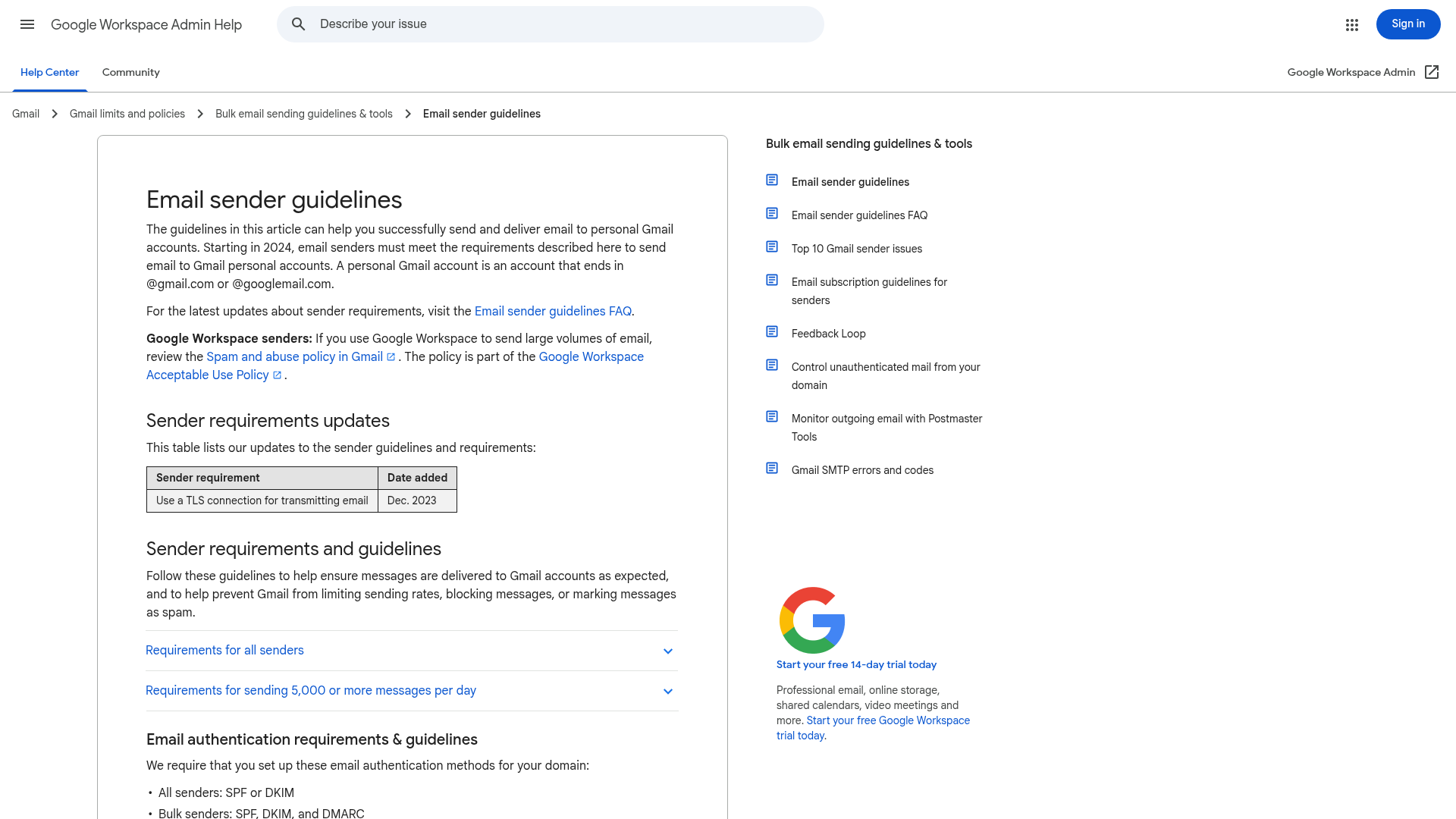
For bulk senders (5,000+/day to Gmail), Google requires all of the following:
- SPF, DKIM, and DMARC. All three, not one. Your domain needs a DMARC policy published — even
p=nonesatisfies the requirement to have a policy, though you should be working toward enforcement. - DMARC alignment. The domain in the visible From header must align with either your SPF domain or your DKIM domain. Alignment is the part that trips people up; passing SPF or DKIM isn't enough if it doesn't align with From.
- One-click unsubscribe (RFC 8058). Marketing and subscribed messages must include a working
List-Unsubscribeheader supporting one-click unsubscribe, plus a clearly visible unsubscribe link in the body. You must process unsubscribe requests within two days. - Spam complaint rate below 0.3%. Keep your Postmaster Tools reported spam rate under 0.30% at all times, and ideally under 0.10%. Spikes above 0.3% lead to throttling or junking; sustained high rates damage domain reputation durably.
Google's own guidelines stress monitoring with Postmaster Tools — it's the only place you see your Gmail-reported spam rate and domain reputation, and it's effectively mandatory instrumentation for any serious sender.
Yahoo (and AOL)
Yahoo was Google's co-author on the 2024 requirements, and its Sender Hub publishes a near-identical list covering Yahoo Mail and AOL. The requirements mirror Gmail's: authenticate with SPF and DKIM, publish DMARC with alignment, support one-click unsubscribe for bulk mail, and keep complaints low.
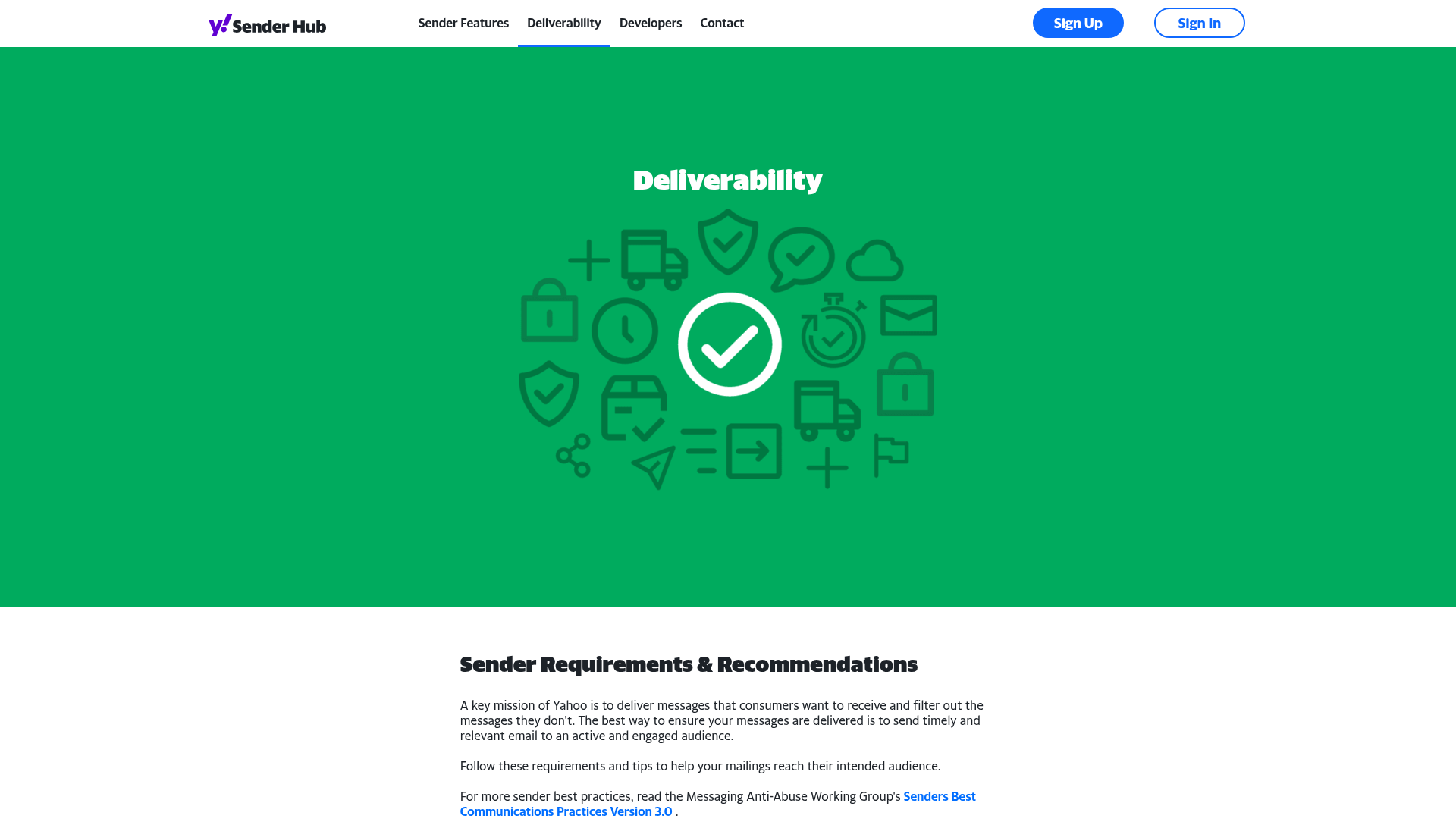
One detail worth calling out: Yahoo explicitly references the Messaging, Malware and Mobile Anti-Abuse Working Group (M3AAWG) Senders Best Communications Practices as the foundation for its expectations. The providers aren't inventing these rules in isolation — they're codifying an industry consensus, which is exactly why they line up so cleanly across mailboxes.
Microsoft: Outlook.com Joins the Club (2025)
For a while, Microsoft was the conspicuous holdout — Outlook.com had its own postmaster guidance but no equivalent enforced bulk-sender list. That changed in 2025. Microsoft announced new requirements for high-volume senders (those sending more than 5,000 messages per day) to consumer domains: outlook.com, hotmail.com, and live.com.
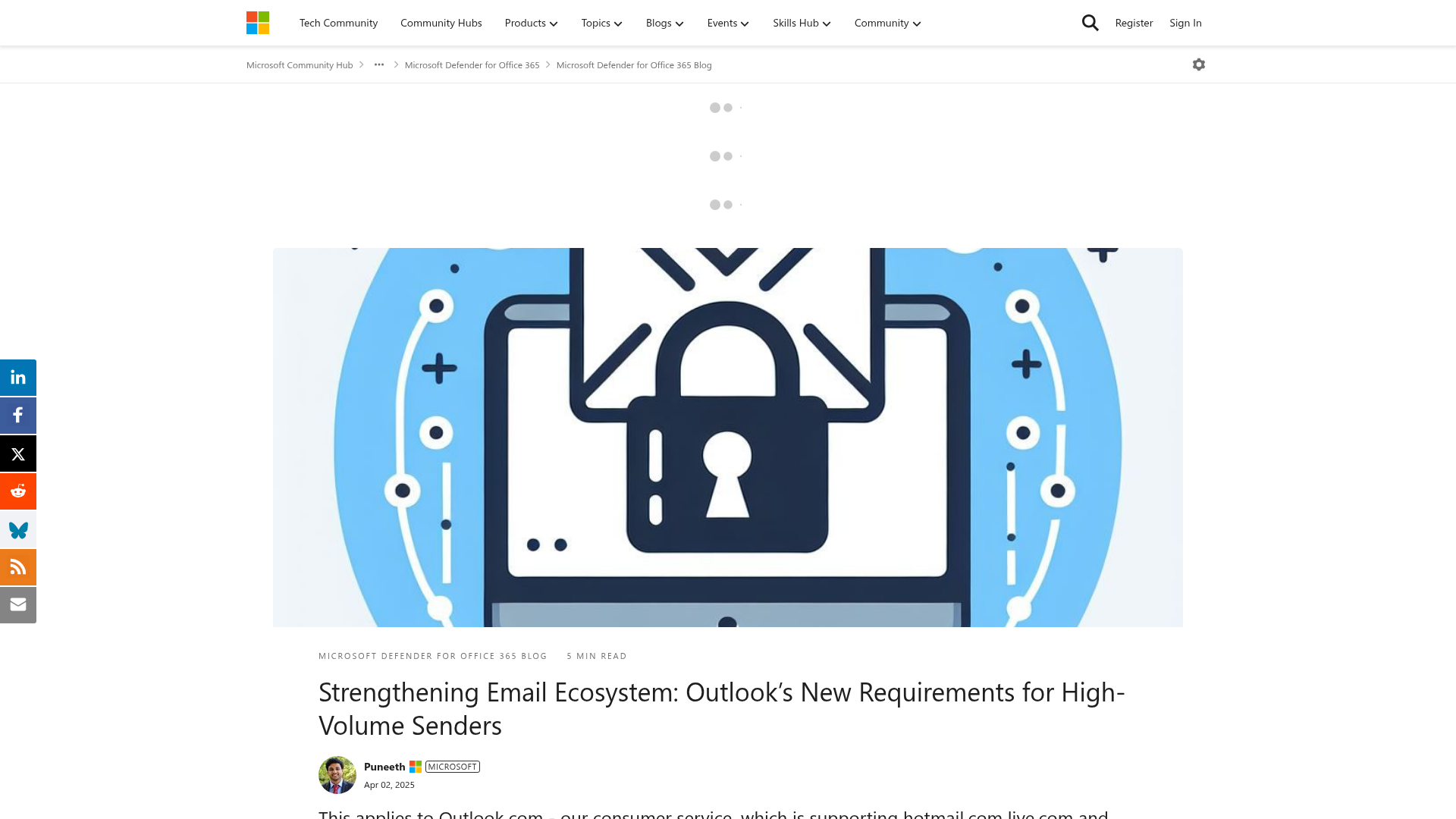
Microsoft's requirements are deliberately aligned with Google and Yahoo: SPF, DKIM, and DMARC, with proper alignment, for high-volume senders. The enforcement approach is graduated — initially, non-compliant high-volume mail is routed to the Junk folder rather than rejected outright, giving senders a remediation window before harder enforcement. The signal is unambiguous, though: the same three authentication standards are now the price of admission to all three of the biggest consumer mail platforms.
Apple / iCloud Mail
Apple is the one major environment without a published Gmail-style requirements table, which leads some senders to wrongly assume it's lax. It isn't. iCloud Mail evaluates SPF, DKIM, and DMARC on inbound mail, factors authentication into placement, and has tightened its handling of unauthenticated and poorly-reputed senders over time. Because Apple Mail is the dominant client (as our MPP retrospective documented), and iCloud Mail is a large and growing mailbox, treating Apple as an afterthought is a mistake.
The practical guidance for Apple is simply the universal baseline plus the bulk-sender authentication trio. There's no separate Apple checklist to learn — meeting the Gmail/Yahoo/Microsoft bar satisfies iCloud Mail too. That's the entire point of convergence.
The Standards Under the Standards: M3AAWG
Both Yahoo and the broader industry point to M3AAWG as the source of the underlying best practices. M3AAWG is the cross-industry working group — mailbox providers, ESPs, security vendors — that publishes the consensus documents the providers' rules are built on.
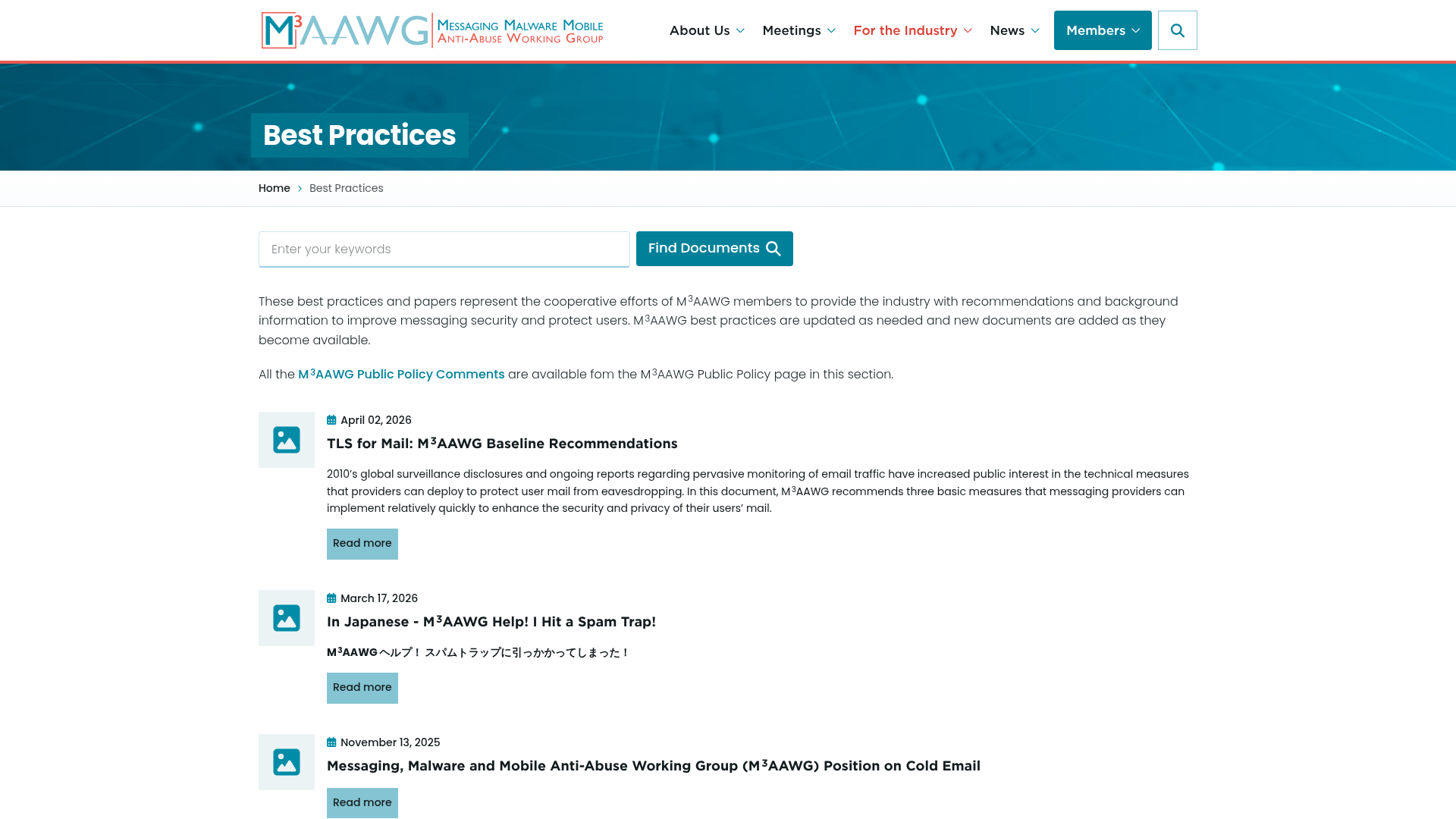
Why does this matter to a working sender? Because it tells you where the puck is going. M3AAWG documents — on TLS for mail, on sender best communications practices, on cold email — preview the requirements that providers later enforce. The clearest current example is authentication's next chapter: DKIM2, which the IETF DKIM working group adopted in March 2026. If you want to be ahead of the next round of requirements rather than scrambling when they land, our DKIM2 explainer is the place to start.
The Consolidated 2026 Checklist
Here is everything above, distilled into one actionable list. Work top to bottom; the first group is non-negotiable for everyone, the second is required once you cross ~5,000 messages/day to any of the big consumer providers.
Every sender, any volume
- Publish and pass SPF or DKIM (do both — it costs nothing extra and you'll need both for bulk anyway).
- Set valid PTR / reverse DNS that resolves back to your sending IP.
- Send over TLS.
- Use an honest, resolvable From domain — never impersonate a provider's domain.
- Format to RFC 5322 with a valid Message-ID.
Bulk senders (~5,000+/day to Gmail, Yahoo, or Outlook.com)
- SPF + DKIM + DMARC, all three, with a published DMARC policy.
- DMARC alignment — From domain aligns with the SPF or DKIM domain.
- One-click unsubscribe (RFC 8058) in the List-Unsubscribe header, plus a visible body link, processed within two days.
- Keep spam complaints under 0.3% (target under 0.1%) as reported by Google Postmaster Tools.
- Support ARC if your mail is forwarded, so authentication survives the hop.
- Monitor with Postmaster Tools (Gmail) and the equivalent provider dashboards; watch reputation and complaint trends continuously.
One operational note: meeting these on paper isn't the same as your email actually rendering and loading correctly in the inbox. Authentication gets you delivered; whether your remote content loads and your unsubscribe link works still depends on your HTML behaving across clients. Our guide on testing HTML emails before sending covers that side, and Postdrop.io lets you preview across Gmail, Outlook, Apple Mail, and the rest before you send.
What's Different About 2026
The single biggest mindset shift is that these are requirements, not optimizations. In 2020, a missing DMARC record was a deliverability risk you might get away with. In 2026, for a bulk sender, it's a reason your mail gets junked or rejected at the door. The providers have stopped grading on a curve.
The second shift is convergence. You no longer need a separate playbook per provider. Meet the consolidated checklist above and you are simultaneously compliant with Gmail, Yahoo, AOL, Outlook.com, and iCloud Mail. The fragmentation that defined deliverability for two decades has, on the requirements side at least, largely collapsed.
And the third — the one our other deliverability coverage keeps hammering — is that authentication and hygiene are the controllable core. With opens compromised by privacy proxies and inboxes increasingly mediated by AI, the things you fully control (your DNS records, your list quality, your complaint rate) are worth more than ever. This checklist is the controllable part. Get it right and you've built deliverability on the part of the system that won't shift under you.
Bottom Line
For the first time, "what do I need to do to get delivered?" has a single, mostly-consistent answer across the major mailbox providers. Authenticate with SPF, DKIM, and DMARC; align your From domain; offer one-click unsubscribe; keep complaints under 0.3%; sort out your reverse DNS and TLS; and monitor with Postmaster Tools. Do that and you clear the bar at Gmail, Yahoo, Microsoft, and Apple at once. The era of provider-by-provider folklore is over — the rules are written down now, and they're the same rules everywhere.
References: Google's Email sender guidelines, the Yahoo Sender Hub, Microsoft's high-volume sender requirements announcement, and M3AAWG's published best practices. Internal: our SPF, DKIM, and DMARC explainer, the DKIM2 authentication upgrade, the Apple MPP retrospective, and our guide to testing HTML emails before sending.